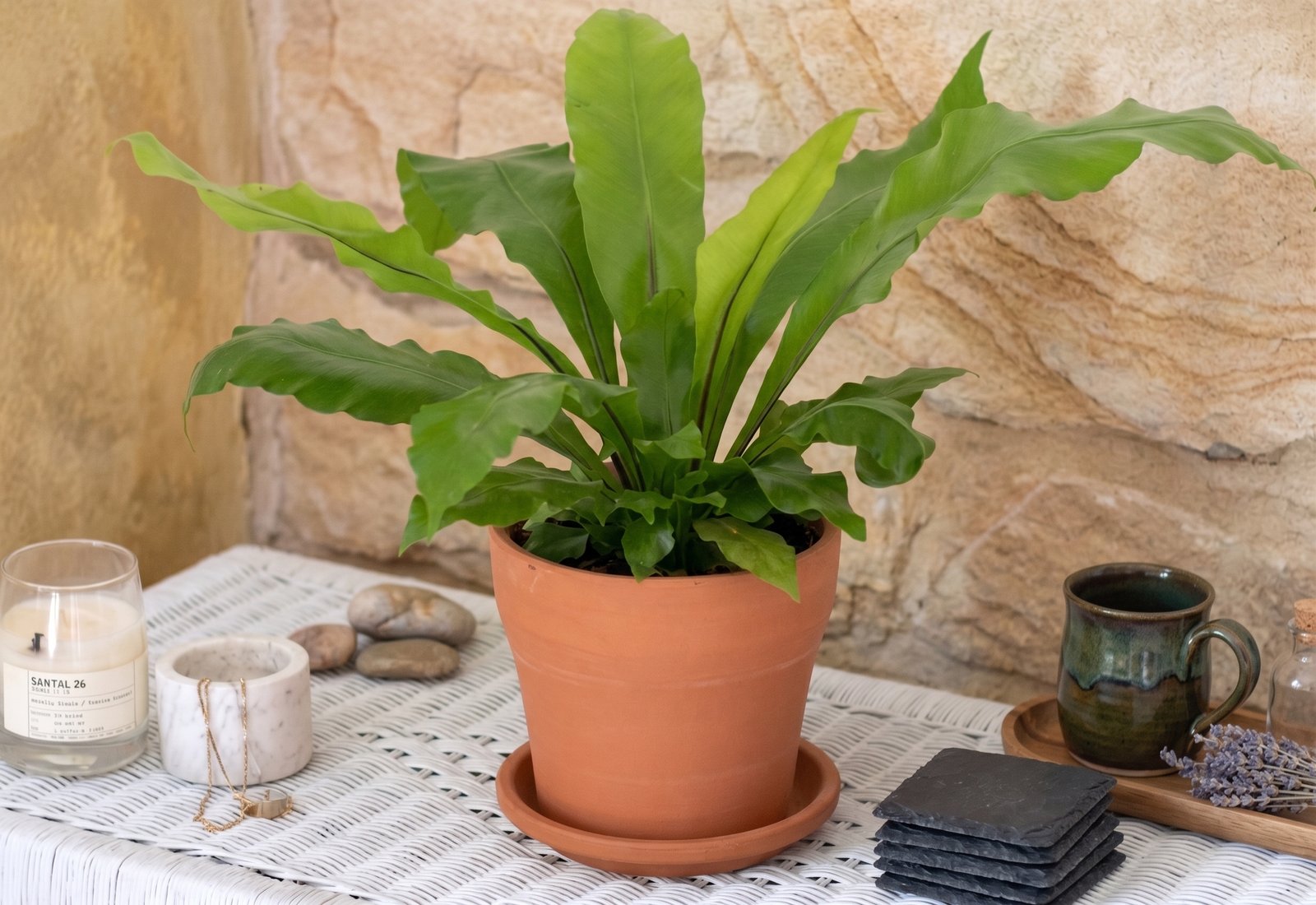
Bird's Nest Fern forms a funnel of broad, undivided fronds with dark central ribs. New fronds emerge from the center and unfurl outward. It looks quite different from the finely divided foliage of a Boston fern or Maidenhair fern.
Several related Asplenium species share the bird's nest common name. This guide is for Asplenium nidus; a nursery label and the whole plant are more useful than a curled leaf alone for identification. Pet safety remains unconfirmed here because the sources checked did not establish an exact-species veterinary classification.
Caring for Your Bird's Nest Fern
Light. Provide filtered light and protection from strong sun. A bright position without hot afternoon rays helps maintain green, undamaged fronds.
Water. Keep the mix lightly moist, allowing the surface to begin drying before watering again. Water the compost around the plant rather than repeatedly filling the central growing point. Empty any collected runoff.
Humidity and warmth. Choose a warm position with high humidity and gentle air movement. Avoid heating vents, cold drafts and contact with cold window glass.
Soil. Use an airy, moisture-retentive fern or houseplant mix in a draining pot. Its epiphytic origins do not mean the roots should be buried in dense, wet garden soil.
Feeding and grooming. Feed lightly while new fronds develop. Handle tender fronds gently and remove fully dead foliage without injuring the central growth. Do not polish leaves with oily products.
Common Problems & Fixes
Brown edges. Investigate dry air, drying roots and fertilizer buildup. Correct the cause before trimming damaged margins.
Pale or bleached patches. Move away from strong direct sun and monitor new growth.
Dark lines underneath. Regular rows of spore-bearing structures on mature fronds are normal. Irregular raised insects or sticky residue require a closer pest check.
Soft center. Persistent wetness at the crown can accompany rot. Improve drainage and avoid pouring water into the central nest.
Scale or mealybugs. Inspect frond undersides and the bases. The foliage is delicate, so check treatment suitability before applying any product.
Propagating Your Bird's Nest Fern
Bird's Nest Fern is propagated from spores, not ordinary leaf cuttings. A mature frond may carry spore-bearing lines on its underside. Raising spores requires clean equipment, moist conditions and patience through several small growth stages.
For most home growers, purchasing a nursery-grown young plant is more straightforward. Do not split the single central crown as though it were a clump of Boston fern; damaging that growing point can ruin the plant.