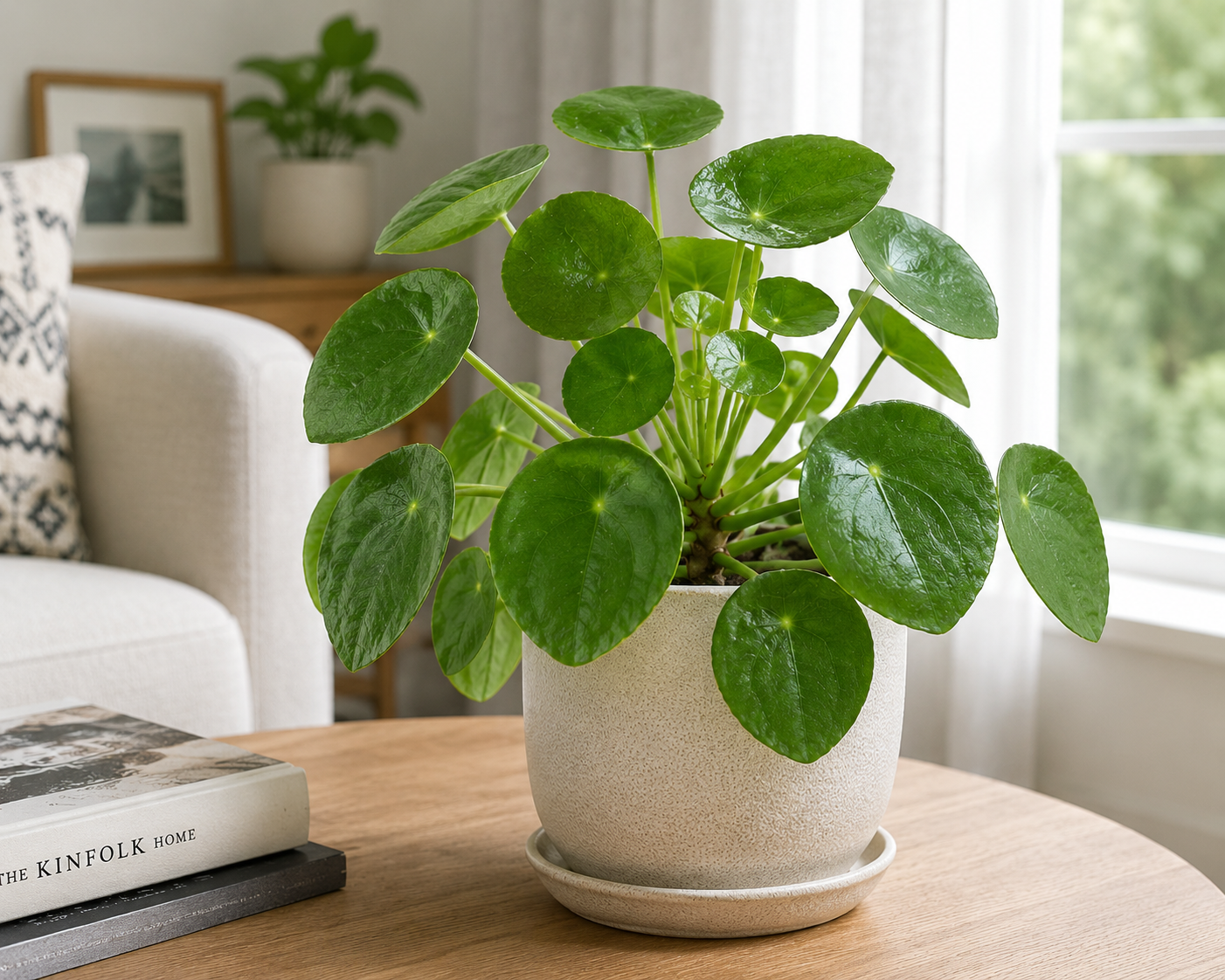
The Chinese Money Plant, or Pilea peperomioides, is one of the most distinctive and charming houseplants around — instantly recognizable for its round, flat, coin-shaped leaves held up on slender stems like little green lily pads. It became a social-media darling for good reason: it's cheerful, compact, pet-safe, and it readily produces baby plants you can share, which is partly how it spread so widely among plant lovers in the first place.
Native to southern China, it was passed hand to hand among growers for years before becoming widely available commercially. That sharing history suits it — a happy Pilea will keep you well supplied with pups to pass along.
Caring for Your Chinese Money Plant
Light. Bright, indirect light is ideal. Good light keeps the plant compact and the leaves full and round; too little light leads to leggy, stretched growth with sparse leaves. Avoid harsh direct sun, which can scorch. Rotating the plant regularly helps it grow evenly, since it leans noticeably toward the light.
Water. Water when the top 2 inches of soil dry out, then drain well. Pileas like to dry out a bit between waterings and dislike soggy soil. Slightly drooping or curling leaves can signal it's thirsty, while yellowing often means too much water.
Humidity. Average household humidity suits it fine.
Soil and potting. A well-draining potting mix with drainage holes. Pileas produce offshoots readily, which you can leave to fill the pot or remove to propagate.
Feeding. Feed lightly with a balanced fertilizer during spring and summer.
Common Problems & Fixes
Leggy growth / long stem with few leaves. The most common complaint, caused by too little light. Move it to a brighter (indirect) spot; rotating it helps keep it symmetrical.
Curling leaves. Can point to a light or watering imbalance, or temperature stress. Some mild cupping is normal; pronounced curling warrants a look at conditions.
Yellowing leaves. Usually overwatering; let the soil dry more.
White crust or spots on leaves. Pileas sometimes exude mineral salts that leave harmless white marks; these can be wiped off.
Drooping. Either thirst (soil dry) or overwatering (soil wet) — check the soil to tell which.
Pests. Relatively trouble-free; occasionally spider mites or fungus gnats in overly wet soil.
Propagating Your Chinese Money Plant
Propagating a Chinese Money Plant is one of its great pleasures, because the plant produces two kinds of babies on its own.
Soil pups emerge from the roots as little plantlets popping up in the pot beside the mother. Once they're a couple of inches tall, dig gently to find where a pup connects to the root, cut it free with a bit of root attached, and pot it up on its own.
Stem babies sometimes appear on the main stem or trunk. These can be cut off and rooted in water or moist soil.
Either way, the pups establish easily, and a healthy Pilea will keep producing them — which is exactly why this plant has been shared from grower to grower for generations.